Why Every Business Needs an AI Regulation Lawyer Before Deploying AI Tools
Understand AI laws in India and why businesses need an AI regulation lawyer to address data privacy, IP, contracts, compliance, and AI governance risks.

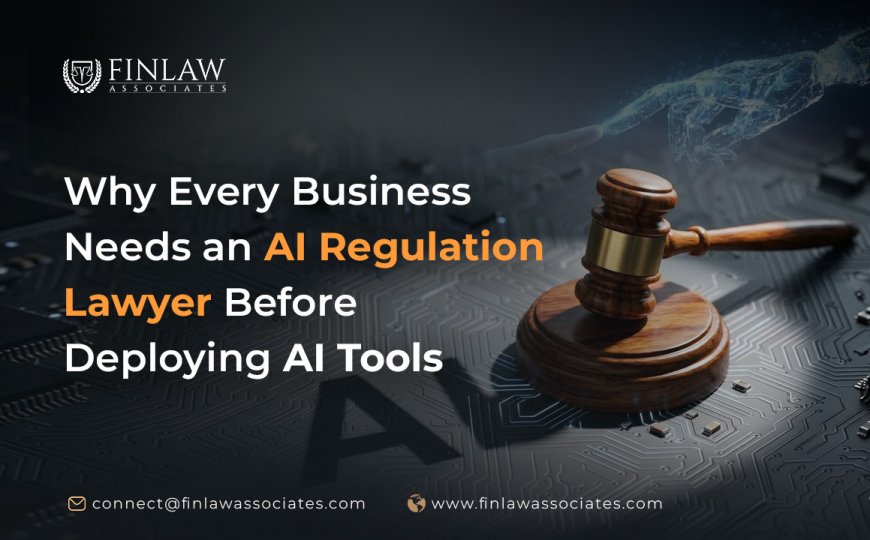
An organization ought to engage an AI regulation lawyer while incorporating artificial intelligence within its operations due to the various legal implications of AI that go well beyond technological considerations. An audit by a lawyer assists in identifying any potential data privacy concerns, intellectual property issues, gaps within the contracts, discrimination, regulatory compliance obligations, and governance issues before the dispute arises.
Artificial Intelligence (AI) is effective at increasing efficiency, saving cost, and making decisions faster. The legal implications of incorporating AI into operations may be overlooked until they arise. Even when a business entity incorporates technologies such as ChatGPT to assist with customer support, recruiting applications, AI contract reviews, fraud detection, and marketing generative AI, the liability lies with the business entity and not the software.
This article will discuss the legal implications of using AI in a business entity, the application of Indian laws on AI, governance considerations, and the reasons why engaging an AI regulation lawyer is cheaper than going through litigation.
AI Regulation Lawyer Responsibilities
AI regulation lawyers advise clients on the legal risks involved in the procurement, use, governance, and scalability of AI technologies. This includes ensuring AI usage is in line with current laws, contractual considerations, regulations, and international standards.
Whereas AI technologists are responsible for implementation of AI, AI regulation lawyers assess the legal ramifications of AI use during its life cycle.
Typical tasks of an AI regulation lawyer include:
-
Examining AI vendor contracts
-
Compliance with data protection laws
-
Governance policy on AI
-
Risks of AI content creation
-
Legal risk assessment of AI
-
Developing AI usage policies
-
Providing advice to the board and executive management team
-
Handling legal investigations after AI occurrences
With regulation of AI becoming a more prominent issue internationally, the need for such legal services is growing.
Five Main Categories of Legal Risk Arising from AI Implementation without Legal Advice
Companies that implement AI systems without seeking legal advice face five major categories of risk: liability risk, privacy risk, intellectual property risk, employment law risk, and contractual risk. The vast majority of lawsuits regarding AI implementation fall into one of these categories.
1. Liability for AI Decisions
The first misconception that most companies have regarding AI is that in case of any error on the part of the AI system, the software company will be held liable.
This is not true.
In cases where the AI chatbot gives bad financial advice, the patient is scheduled incorrectly by a medical appointment scheduling software, or a claims processing software system refuses service unfairly to customers, the liability rests with the company which uses the AI.
The factors considered include:
-
Reasonable oversight
-
Human review
-
Unforeseen risk
-
Loss to customers
2. Data Privacy Risks
Most AI systems use substantial amounts of personal or confidential data.
Some examples are:
-
Employment files
-
E-mails from customers
-
Financial statements
-
Contracts
-
Medical records
-
In-house corporate documentation
Loading confidential data into third-party AI platforms without proper protection could create legal and contract risks.
Organizations need to be aware of:
-
Storage locations
-
Storage of prompts
-
Usage for training the model
-
Transfers across borders
-
Security standards of vendors
All these issues are legal, not just technological.
3. Intellectual Property Risks
The generative AI technology has changed ownership of intellectual property.
Some areas that can give rise to controversies are:
-
Copying of marketing made by AI that imitates existing content
-
Violations of copyright
-
Misuse of trademarks
-
Ownership of the material generated by AI
-
Controversies related to training data
Organizations need to think about the possibility of their employees uploading confidential code and trade secrets into public AI systems.
4. Employment and Discrimination Risk
Organisations today utilise AI to:
-
Filter resumes
-
Rank candidates
-
Watch employees' performance
-
Assess performance
-
Make promotion recommendations
Employers are at risk of facing discrimination lawsuits even when the AI system is the cause of the discrimination.
Human intervention is key.
5. Legal Risks in Contracts
Undoubtedly, one of the greatest risks is related to vendor contracts.
Organisations sign off on standard vendor contracts without knowing who is responsible for any mishap that happens.
The negotiated contract often defines the party liable in the event of an AI dispute.
Legal Standing of India regarding AI
There is no existing AI law in India. Companies deploying AI are required to follow the existing laws dealing with privacy, cybersecurity, contract law, consumer protection laws, intellectual property laws, labor laws, and other industry-specific laws.
Some of the important statutes that companies need to follow include:
Digital Personal Data Protection Act, 2023
In the case where personal data is processed through AI, some important issues include:
-
Lawful processing
-
Purpose limitation
-
Security measures
-
Rights of data principals
-
Cross-border data transfers
-
Vendor obligations
AI deployment using customer or employee data may need to consider DPDP as well.
Information Technology Act, 2000
The IT Act will continue to be applicable for:
-
Electronic record
-
Cybersecurity
-
Digital evidence
-
Intermediary obligations
-
Computer-related offenses
Despite having been enacted a very long time ago, before generative AI, much of it remains relevant.
Other Relevant Laws
Depending upon the nature of the business, AI can also be associated with:
-
Consumer protection laws
-
Competition law
-
Labor laws
-
Copyright law
-
Trademark law
-
Contract law
-
Laws governing the financial sector
-
Regulations for healthcare
AI being an unregulated technology doesn’t imply that there are no rules regulating AI.
Comparison with the Rest of the World: EU AI Act
The EU AI Act is not applicable to the majority of Indian enterprises but will help in understanding where the world is heading with respect to AI regulations.
The EU AI Act includes a risk-based approach wherein AI applications are classified as:
-
Unacceptable risk
-
High risk
-
Limited risk
-
Minimal risk
High-risk AI systems require certain obligations regarding:
-
Risk Management
-
Human oversight
-
Documentation
-
Transparency
-
Accuracy
-
Monitoring
Scenarios of Liability That Businesses Should Consider
It is hard to appreciate the legal consequences of AI without concrete examples of real-life situations.
Scenario 1: AI Generates Financial Losses
AI financial advisory chatbot provides bad investment recommendations.
Client acts upon those recommendations and loses a lot of money.
Legal implications may include:
-
Negligence
-
Misrepresentation
-
Complaints from consumers
-
Regulatory investigation
-
Disputes related to contracts
Scenario 2: Hiring Process with AI Leads to Discrimination
Recruitment platform refuses to consider qualified female applicants due to biased training data.
Possible implications may be:
-
Employment discrimination cases
-
Investigations
-
Bad reputation
Scenario 3: Generated Advertising Material Infringes Rights of Others
Marketing department uses generative AI to produce advertising materials.
Material created by AI inadvertently infringes copyright rights or defamation laws.
Possible legal problems may include:
-
Copyright infringement
-
Trademark disputes
-
Defamation cases
-
Injunctions
-
Damages
AI Vendor Agreements: The Key Clauses Business Owners Often Overlook
An AI vendor agreement will usually place many risks on the client. It is important that businesses get their contracts checked for AI regulation before signing.
AI Vendor Agreement Check List
-
Caps on liability
-
Indemnities
-
Data ownership rights
-
Access to training data
-
Confidentiality clauses
-
Security measures
-
Rights to auditing
-
Cooperation with regulators
-
Service levels
-
Model updating terms
-
Sub-processors
-
Incident notification
-
Termination terms
-
Cross-border data transfer terms
-
IP Ownership
The agreement must make clear:
-
Ownership of AI produced results
-
Use of uploaded data to update the model
-
If and who is responsible in case of any legal issue
-
Provisions post termination
-
Access of regulator to the documents
These are some of the key clauses usually overlooked while negotiating the contract.
The Importance of AI Governance from the Board Perspective
AI governance is becoming an important matter of governance rather than a technical matter. The board needs to create proper accountability for AI implementation, manage material risks, and ensure that management has the proper controls in place.
Proper AI governance usually entails:
-
Board oversight of important AI implementations
-
Risk assessment of AI prior to deployment
-
Approval process documentation
-
Human approval of high-impact decisions
-
Ongoing compliance review
-
Employee education and training
-
Incident reporting process
-
Vendor due diligence
-
AI policies
-
Proper internal audit involvement if necessary
AI should be governed in the same way cybersecurity or enterprise risk management should be.
At Which Points Should You Consult an AI Regulation Lawyer?
The use of an AI regulation lawyer can be considered by businesses in several stages in adopting AI technology, not just when legal problems have arisen.
Before Acquisition
Look into:
-
Vendor agreements
-
Privacy assurances
-
Licenses
-
Security requirements
-
Before Implementation
Analyze:
-
Risks of non-compliance
-
Policies
-
Use by employees
-
Customer information
-
Before Expansion
Consider:
-
Governance
-
Risk management
-
International business
-
Cross-border regulation
-
Regulations by industry
-
Following an Incident
An attorney is necessary when there is:
-
A customer complaint
-
A data breach
-
Harmful output from the AI
-
Investigation by regulators
-
Employment dispute
It is typically much more costly to wait for legal action to begin than to do some legal work beforehand.
Expert Insight
It is also a myth that the use of AI gives rise to wholly novel legal issues. More often than not, AI serves to exacerbate pre-existing legal responsibilities.
Organisations are bound to secure people’s personal information, ensure non-discrimination, protect intellectual property rights, and mitigate risks associated with contracts. AI just accelerates the process of doing all this.
Organisations that are likely to encounter the toughest legal obstacles are not necessarily those that implement the most sophisticated AI technology. On the contrary, these are likely to be organisations that adopt AI technology rapidly without documenting governance, vendor agreements, and human involvement.
FAQs about AI Law in India
Is there an AI law in India?
There is no AI law in India. Corporations that use AI technologies must adhere to the laws applicable at present in India. This includes the Information Technology Act, 2000, the Digital Personal Data Protection Act, 2023 (where relevant), contract law, intellectual property law, consumer law, employment law, and any industry-specific regulation.
Which entity will be liable in case of error made by the AI, the company using it or the vendor selling it?
Depending on specific circumstances, the contract between the parties, and applicable laws, the answer could vary greatly. However, in most cases, the company itself would remain liable to its customers or employees, whereas liability to the vendor would depend on the contractual relationship. Thus, it is highly advisable to review vendor contracts before using AI solutions.
Does a small business require an AI regulation lawyer?
Yes, especially if AI solutions are used to process customer information, create public-facing content, make employment decisions, automate corporate processes, or work with commercially confidential information. Smaller businesses do not have much financial capacity to withstand legal proceedings.
Artificial intelligence is becoming an integral part of our daily business processes, yet liability cannot be delegated to software companies. Every implementation of AI is inevitably associated with privacy concerns, intellectual property disputes, risk allocation, governance, and accountability.
A lawyer on AI regulation assists organisations in addressing those issues even before they give rise to litigation, regulatory investigations, or damage to reputation. Regardless of whether your company is exploring its first AI solution or implementing AI on a broader scale, consulting a legal professional at the early stage of development will be useful for you.
What's Your Reaction?