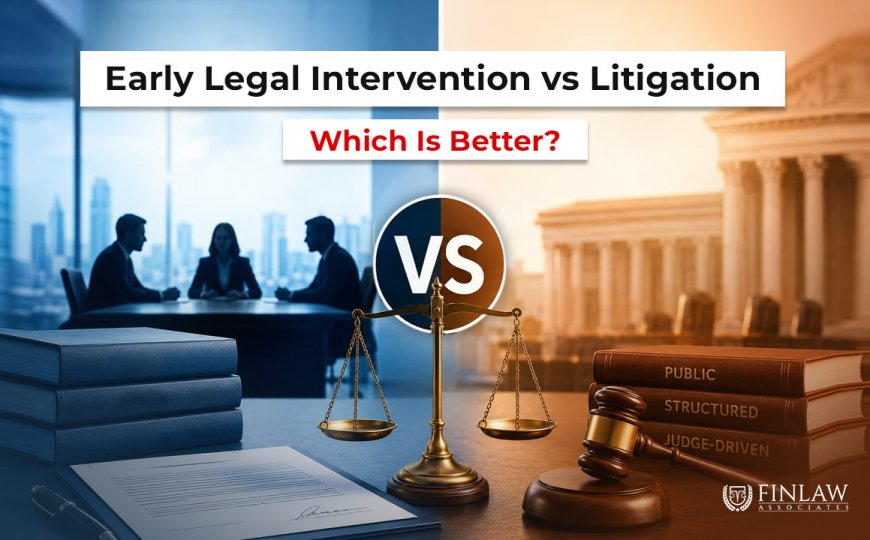
Early Legal Intervention vs Litigation: Which Approach Saves More Time and Money?
Compare early legal intervention and litigation, understand their costs, benefits, risks, and learn which approach delivers better outcomes.

Why Solving Legal Problems Early Often Costs Less Than Fighting Them Later
When legal issues arise, many individuals and businesses wait until a dispute becomes serious before seeking legal assistance. Unfortunately, by the time a matter reaches litigation, the damage may already be substantial—relationships may be strained, financial losses may have accumulated, and resolution may become significantly more expensive.
This raises an important question:
Is it better to involve a lawyer early and prevent disputes from escalating, or should legal action only be taken once litigation becomes unavoidable?
The answer depends on the circumstances, but in many cases, early legal intervention can save considerable time, money, and stress while reducing the likelihood of lengthy court proceedings.
This article compares early legal intervention and litigation, explains the advantages and limitations of each approach, and helps businesses and individuals determine which strategy is most appropriate. It also explores how a legal retainer can help organizations address legal risks before they become costly disputes.
Summary
-
Early legal intervention focuses on preventing disputes or resolving them before they escalate.
-
Litigation involves formal legal proceedings before a court or tribunal.
-
Preventive legal advice is often more cost-effective than dispute resolution.
-
Many commercial, employment, contractual, and regulatory issues can be resolved without litigation.
-
Litigation remains necessary in certain situations where negotiation or settlement is not possible.
-
Businesses that maintain ongoing legal support often identify and manage risks earlier.
-
A proactive legal strategy can reduce financial, operational, and reputational risks.
Early Legal Intervention vs Litigation: Which Is Better?
In most situations, early legal intervention is preferable because it helps identify risks, prevent disputes, preserve business relationships, and reduce legal costs before problems escalate.
However, litigation may become necessary when:
-
Negotiations fail
-
Rights need judicial enforcement
-
Regulatory action must be challenged
-
Contract breaches remain unresolved
-
Significant disputes require formal adjudication
The most effective legal strategy is often to prevent litigation where possible and pursue it only when necessary.
Understanding Early Legal Intervention
What Is Early Legal Intervention?
Early legal intervention refers to obtaining legal advice or taking legal action at the first sign of a legal issue rather than waiting for a full-scale dispute to develop.
Instead of reacting to problems after they occur, individuals and businesses take proactive steps to address risks early.
Examples include:
-
Reviewing contracts before signing
-
Responding promptly to legal notices
-
Addressing employment disputes early
-
Seeking advice during regulatory investigations
-
Resolving shareholder disagreements before escalation
-
Negotiating settlements before court proceedings begin
The objective is prevention rather than reaction.
Why Early Legal Intervention Matters
Legal problems rarely appear overnight.
Most disputes develop gradually through:
-
Miscommunication
-
Contractual misunderstandings
-
Compliance failures
-
Regulatory concerns
-
Business disagreements
-
Payment defaults
-
Employment issues
Early legal guidance can often identify solutions before positions become entrenched and disputes become harder to resolve.
Understanding Litigation
What Is Litigation?
Litigation is the formal process of resolving disputes through courts, tribunals, or judicial authorities.
When parties cannot resolve a disagreement through negotiation or alternative methods, litigation may become necessary.
Typical litigation matters include:
-
Contract disputes
-
Commercial disputes
-
Property disputes
-
Employment disputes
-
Regulatory challenges
-
Recovery proceedings
-
Intellectual property disputes
Litigation provides a legally enforceable mechanism for resolving conflicts.
Why Litigation Exists
Litigation plays an important role in the legal system.
It allows parties to:
-
Enforce legal rights
-
Seek compensation
-
Obtain injunctions
-
Resolve disputes conclusively
-
Challenge unlawful actions
-
Protect business interests
While litigation is often viewed negatively because of cost and delays, it remains an essential remedy in many situations.
Early Legal Intervention vs Litigation: A Side-by-Side Comparison
At a Glance
|
Factor |
Early Legal Intervention |
Litigation |
|
Objective |
Prevent disputes |
Resolve disputes |
|
Cost |
Usually lower |
Usually higher |
|
Time |
Often faster |
Often longer |
|
Relationship Impact |
Preserves relationships |
May damage relationships |
|
Risk Management |
Proactive |
Reactive |
|
Flexibility |
High |
Limited by procedural rules |
|
Confidentiality |
Easier to maintain |
Often becomes part of public proceedings |
|
Business Disruption |
Lower |
Higher |
Cost Comparison
Which Approach Is More Cost-Effective?
One of the biggest differences between early intervention and litigation is cost.
Early Legal Intervention
Costs often involve:
-
Legal consultations
-
Contract reviews
-
Compliance assessments
-
Negotiation support
-
Preventive advice
These expenses are generally predictable and manageable.
Litigation
Costs may include:
-
Court fees
-
Legal representation
-
Expert witnesses
-
Evidence collection
-
Document management
-
Multiple hearings
-
Appeals
The total cost can increase significantly as proceedings continue.
Practical Reality
Many disputes that eventually cost lakhs or crores in litigation could have been prevented through relatively modest early legal advice.
Time Comparison
Which Option Resolves Issues Faster?
Early Legal Intervention
Problems may be addressed:
-
Before formal disputes arise
-
During negotiations
-
Through settlement discussions
-
Through compliance corrections
Resolution can often occur within weeks or months.
Litigation
Court proceedings frequently involve:
-
Pleadings
-
Evidence stages
-
Hearings
-
Adjournments
-
Appeals
Complex litigation can continue for years.
For businesses, delayed resolution often creates uncertainty and operational disruption.
Impact on Business Relationships
Preserving Relationships Matters
Not every legal dispute involves adversaries.
Many disputes arise between:
-
Business partners
-
Vendors
-
Clients
-
Employees
-
Shareholders
-
Investors
Early Intervention
Encourages:
-
Communication
-
Negotiation
-
Practical solutions
-
Relationship preservation
Litigation
Can lead to:
-
Adversarial positions
-
Public conflict
-
Reputational issues
-
Permanent relationship breakdowns
Where ongoing relationships matter, early intervention is often preferable.
Risk Management Perspective
Prevention Is Often Better Than Cure
One of the biggest advantages of early legal involvement is risk management.
Lawyers can identify:
-
Contractual weaknesses
-
Regulatory exposure
-
Governance concerns
-
Compliance deficiencies
-
Documentation gaps
Addressing these issues early may prevent disputes entirely.
Litigation, by contrast, addresses problems after they have already materialized.
When Early Legal Intervention Is Usually the Better Choice
Common Situations
Contract Reviews
Reviewing agreements before execution can prevent future disputes.
Regulatory Compliance
Identifying compliance risks early reduces enforcement exposure.
Employment Matters
Addressing workplace issues promptly may avoid labor disputes.
Commercial Negotiations
Early legal input can protect business interests before commitments are made.
Shareholder Disputes
Prompt intervention may prevent governance deadlocks and litigation.
When Litigation May Be Necessary
Situations Where Court Action Becomes Important
Despite the benefits of prevention, litigation is sometimes unavoidable.
Breach of Contract
When a party refuses to honor contractual obligations.
Recovery of Significant Amounts
Where negotiations fail and legal enforcement becomes necessary.
Injunction Matters
When immediate judicial protection is required.
Regulatory Challenges
Where administrative decisions must be challenged.
Fraud Cases
Where serious misconduct requires formal legal action.
Intellectual Property Infringement
When rights need enforcement through judicial remedies.
In such cases, litigation serves as an important legal tool.
Why Businesses Are Moving Toward Preventive Legal Strategies
The Shift From Reactive to Proactive Legal Management
Modern businesses increasingly view legal services as a strategic function rather than an emergency service.
Instead of asking:
"What do we do now that a dispute exists?"
They ask:
"How do we prevent the dispute from occurring in the first place?"
This shift has driven increased adoption of:
-
Compliance programs
-
Governance frameworks
-
Contract management systems
-
Ongoing legal advisory arrangements
-
Risk assessments
The Role of a Legal Retainer in Early Intervention
Why Ongoing Legal Access Matters
One reason businesses delay seeking legal advice is uncertainty regarding cost and accessibility.
A legal retainer can address this challenge by providing ongoing access to legal guidance before issues escalate.
Instead of waiting for a crisis, businesses can obtain assistance with:
-
Contract reviews
-
Compliance questions
-
Legal notices
-
Employment issues
-
Regulatory concerns
-
Risk assessments
-
Commercial negotiations
This proactive approach often reduces the likelihood of expensive litigation.
Signs You Should Seek Legal Advice Immediately
Do Not Wait If You Notice:
-
A serious contract dispute developing
-
Regulatory inquiries
-
Employee grievances escalating
-
Shareholder disagreements
-
Payment defaults
-
Legal notices
-
Compliance concerns
-
Potential fraud allegations
Early action can significantly improve available options.
Top Benefits of Early Legal Intervention
|
Benefit |
Impact |
|
Lower Costs |
Reduces future legal expenses |
|
Faster Resolution |
Prevents prolonged disputes |
|
Better Risk Management |
Identifies problems early |
|
Relationship Preservation |
Supports negotiation and settlement |
|
Greater Business Stability |
Minimizes operational disruption |
|
Improved Compliance |
Reduces regulatory exposure |
|
Strategic Decision-Making |
Enhances long-term planning |
Frequently Asked Questions
Is Early Legal Intervention Always Better Than Litigation?
Not always. However, in many situations, early intervention can prevent disputes from escalating and reduce costs.
Can Early Legal Advice Prevent Lawsuits?
In many cases, yes. Identifying and addressing risks early can significantly reduce the likelihood of litigation.
Does Litigation Mean Negotiation Has Failed?
Often, litigation occurs after attempts at negotiation or settlement have not resolved the dispute.
Why Is Litigation More Expensive?
Litigation typically involves court procedures, legal representation, evidence preparation, hearings, and potential appeals.
Do Small Businesses Benefit From Early Legal Advice?
Absolutely. Early legal guidance can help small businesses avoid costly mistakes and disputes.
What Types of Issues Should Be Addressed Early?
Contract matters, compliance concerns, employment disputes, regulatory issues, shareholder disagreements, and commercial negotiations are all strong candidates for early intervention.
How Can a Legal Retainer Help Prevent Litigation?
A legal retainer provides ongoing legal support, allowing businesses to address risks proactively rather than waiting until disputes require formal legal proceedings.
Final Thoughts
When comparing early legal intervention and litigation, the question is not whether litigation is good or bad. Litigation remains an essential mechanism for enforcing rights and resolving disputes when other options fail.
However, the reality is that many legal disputes could be avoided—or significantly reduced—through timely legal advice, effective risk management, and proactive decision-making.
Early legal intervention often provides substantial advantages in terms of cost, speed, flexibility, relationship preservation, and business continuity. By identifying problems before they escalate, individuals and businesses can often achieve better outcomes with fewer disruptions.
For organizations seeking to reduce legal risk and operate more strategically, maintaining access to ongoing legal guidance through a legal retainer can be an effective way to manage issues before they evolve into expensive and time-consuming litigation.
What's Your Reaction?