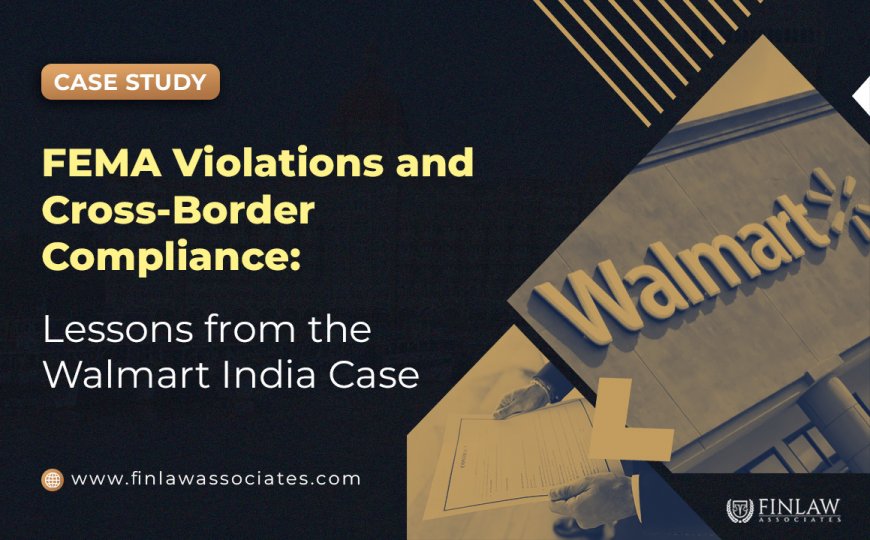
FEMA Violations and Cross-Border Compliance: Lessons from the Walmart India Case
Learn how FEMA compliance lapses in Walmart India’s cross-border investments triggered regulatory scrutiny and what businesses must do to avoid violations.

Cross-border investments have become a vital part of India’s economic growth, allowing global corporations to participate in the country’s rapidly expanding market. However, foreign investment transactions in India must comply with the Foreign Exchange Management Act (FEMA) and related regulations issued by the Reserve Bank of India (RBI).
When companies fail to follow FEMA rules, they may face investigations, penalties, and reputational damage. One widely discussed example is the Walmart India FEMA compliance proceedings, which highlighted the risks companies face when cross-border transactions are not structured properly.
The case serves as an important reminder for multinational companies and investors about the importance of continuous FEMA advisory and legal compliance.
Understanding FEMA and Cross-Border Regulations in India
The Foreign Exchange Management Act, 1999 (FEMA) governs foreign exchange transactions in India. It regulates how foreign investments, cross-border payments, and overseas transactions are conducted.
FEMA aims to:
-
Facilitate external trade and payments
-
Maintain stability in the foreign exchange market
-
Regulate foreign investments into and out of India
Under FEMA, companies must follow strict procedures for Foreign Direct Investment (FDI) transactions, including documentation, reporting, and approval requirements.
Two key regulatory authorities oversee FEMA compliance:
Reserve Bank of India (RBI)
The RBI is responsible for formulating foreign exchange regulations and monitoring compliance with FDI reporting requirements.
Enforcement Directorate (ED)
The Enforcement Directorate, operating under the Ministry of Finance, investigates violations of FEMA regulations and can impose penalties or initiate legal proceedings.
Failure to comply with FEMA rules can result in monetary penalties, regulatory action, or even restrictions on future investments.
Walmart India and FEMA Violation Proceedings
The Walmart India case attracted attention due to allegations related to FEMA compliance lapses and improper structuring of foreign investment transactions.
Walmart entered the Indian market through several investment structures, including partnerships and joint ventures. As with any multinational investment, these transactions required compliance with FEMA rules governing foreign ownership, reporting, and approvals.
Regulators reportedly examined certain transactions to determine whether the company had followed all required FEMA procedures.
The investigation focused on issues such as:
-
Whether foreign investment structures complied with Indian regulations
-
Whether cross-border transactions were properly reported
-
Whether regulatory filings were completed within the prescribed timeframes
While large multinational companies often manage complex investment structures, even minor procedural lapses in cross-border transactions can trigger regulatory scrutiny.
Key FEMA Compliance Issues Highlighted
The proceedings surrounding Walmart India emphasized several common FEMA compliance risks faced by multinational corporations.
Improper Structuring of Foreign Investment
Foreign investment transactions must follow specific rules regarding ownership structures, sectoral caps, and approval requirements.
If investments are structured incorrectly - such as through complex intermediary entities or misclassified instruments - they may violate FEMA guidelines.
Improper structuring can also lead to regulatory concerns regarding:
-
Round-tripping of funds
-
Indirect foreign ownership
-
Circumvention of sectoral investment caps
Even when transactions are commercially legitimate, improper documentation or structuring may result in regulatory penalties.
Delayed or Incorrect Reporting
FEMA requires companies to file several forms when foreign investments occur.
Two of the most important filings include:
-
Form FC-GPR – used to report the issue of shares to foreign investors
-
Form FC-TRS – used to report the transfer of shares between residents and non-residents
These filings must be submitted within specific timelines after the transaction.
Delays or incorrect filings can result in FEMA violations, even if the underlying transaction is legally permitted.
Documentation and Regulatory Transparency
Regulators require detailed records for cross-border transactions, including:
-
Share subscription agreements
-
Board resolutions
-
Valuation certificates
-
Investment documentation
If documentation is incomplete or inconsistent, regulators may question whether the investment structure complies with FEMA.
In large multinational transactions involving multiple entities and jurisdictions, maintaining accurate documentation becomes critical.
Regulatory Scrutiny and Investigation
When regulators suspect FEMA violations, the matter may be investigated by the Enforcement Directorate (ED).
The ED has authority to:
-
Examine financial transactions
-
Request documentation from companies
-
Conduct investigations into foreign exchange violations
If a violation is confirmed, companies may face enforcement proceedings under FEMA.
These proceedings can lead to penalties or compounding orders depending on the severity of the violation.
Impact of FEMA Violations
Cross-border compliance failures can create significant challenges for companies operating in India.
The Walmart case illustrates several potential consequences.
Regulatory Scrutiny
Once regulators initiate an investigation, companies may face extended scrutiny of their financial and operational activities.
This may involve multiple regulatory authorities reviewing transactions and corporate structures.
Such scrutiny can delay future approvals and complicate investment decisions.
Monetary Penalties
Under FEMA, monetary penalties may be imposed for violations.
Penalties can vary depending on the nature of the violation but may include:
-
Fines proportional to the amount involved in the transaction
-
Additional penalties for continued non-compliance
-
Compounding fees for settlement of violations
These financial consequences can become substantial, particularly in large investment transactions.
Reputational Concerns
For multinational corporations, regulatory investigations can affect reputation and investor confidence.
Companies operating in global markets must maintain strong compliance records to preserve trust with:
-
regulators
-
investors
-
partners
-
consumers
Even procedural violations may attract significant media attention and public scrutiny.
The Role of FEMA Compounding
In many cases, companies seek compounding of FEMA violations, which allows them to settle the matter by paying a compounding fee instead of undergoing lengthy litigation.
The compounding process involves:
-
Admission of the violation
-
Submission of an application to the RBI
-
Payment of a prescribed compounding amount
While compounding can resolve the issue, the costs can increase significantly depending on:
-
the duration of non-compliance
-
the value of the transaction
-
the nature of the violation
This makes preventive compliance far more cost-effective than post-facto correction.
Why Continuous FEMA Advisory Is Essential
The Walmart case highlights a critical lesson for multinational companies: cross-border compliance must be proactive rather than reactive.
Foreign investment transactions often involve complex regulatory requirements that change frequently.
Without ongoing legal and regulatory guidance, companies may unintentionally violate FEMA rules.
A continuous FEMA advisory retainer can help businesses manage these risks effectively.
How a Legal Retainer Helps Prevent FEMA Violations
Companies engaging in foreign investment activities benefit from having dedicated legal advisors who monitor compliance requirements on an ongoing basis.
Monitoring FDI Reporting Obligations
Legal advisors ensure timely filing of mandatory forms such as:
-
FC-GPR
-
FC-TRS
-
LLP-I and LLP-II filings
-
Annual FLA returns
Proper monitoring prevents reporting delays that could otherwise trigger penalties.
Structuring Cross-Border Transactions Correctly
Legal experts review foreign investment structures to ensure compliance with:
-
sectoral caps
-
automatic vs approval routes
-
pricing guidelines
-
valuation requirements
This prevents structuring mistakes that may later be considered regulatory violations.
Managing Regulatory Documentation
Corporate legal retainers ensure that all cross-border investment documentation is accurate and compliant.
This includes reviewing:
-
shareholder agreements
-
share subscription agreements
-
board resolutions
-
investment documentation
Proper documentation reduces the risk of disputes with regulators.
Avoiding Expensive Litigation
Preventive compliance significantly reduces the likelihood of enforcement proceedings.
By addressing regulatory risks early, companies can avoid:
-
enforcement investigations
-
compounding fees
-
prolonged legal battles
In highly regulated areas like foreign investment, prevention is always more cost-effective than corrective litigation.
Key Lessons for Multinational Companies
The Walmart India FEMA proceedings offer several important insights for businesses operating in cross-border markets.
First, compliance with foreign exchange regulations must be integrated into the company’s investment strategy.
Second, cross-border transactions require careful structuring and documentation to meet regulatory standards.
Third, timely reporting and accurate filings are essential to avoid regulatory violations.
Finally, companies should maintain ongoing legal and compliance oversight rather than relying on occasional legal consultations.
The Walmart India FEMA proceedings highlight the complexities involved in cross-border investment compliance in India. Even large multinational corporations with extensive legal resources can face regulatory scrutiny when foreign investment transactions are not structured or reported correctly.
FEMA regulations are designed to ensure transparency and stability in India’s foreign exchange system. However, navigating these rules requires careful planning, continuous monitoring, and expert legal guidance.
Businesses that rely solely on reactive legal support often discover compliance issues only after regulators initiate investigations.
A corporate legal retainer with ongoing FEMA advisory services allows companies to detect potential issues early, structure transactions correctly, and maintain regulatory compliance.
In the evolving landscape of international investment, proactive compliance is the most effective way to avoid penalties, protect reputation, and ensure smooth cross-border operations.
What's Your Reaction?