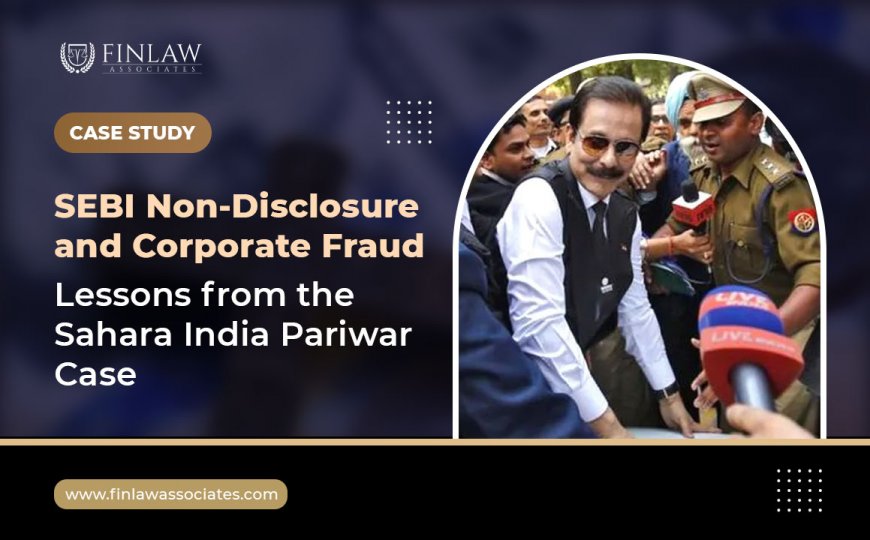
SEBI Non-Disclosure and Corporate Fraud: Lessons from the Sahara India Pariwar Case
SEBI vs Sahara explained: how illegal fundraising and disclosure failures led to massive penalties and the compliance lessons businesses must learn.

Corporate governance and regulatory compliance play a crucial role in maintaining transparency and trust in financial markets. When companies fail to comply with securities regulations, the consequences can be severe - not only for the business but also for investors and the broader financial system.
One of the most notable examples of regulatory enforcement in India is the Sahara India Pariwar case, which involved allegations of illegal fundraising, lack of disclosure, and violations of securities laws. The case drew significant attention from regulators, courts, and the public, ultimately becoming one of the largest corporate legal battles in Indian financial history.
This article examines the Sahara case, the role of the Securities and Exchange Board of India (SEBI), the regulatory violations involved, and the lessons businesses can learn about compliance and legal oversight.
What is SEBI’s Role in the Regulation of Corporates?
SEBI has been established as the central regulatory authority for the Indian Securities Market is charged with the protection of investors by providing transparency and fairness to the capital markets.
The main areas of regulation carried out by SEBI centre on:
-
The Public Offer of Funds via Securities
-
Corporate Disclosures
-
Mechanisms for Investor Protection
-
Market Transparency and Integrity
Under the SEBI Act, every entity offering to raise funds from the public must adhere to all regulations issued by SEBI and the Act which requires:
-
Adequate Documentation
-
Best Practice Regulatory Approvals
-
Adequate Disclosure
Any entity failing to comply with these Regulations may be subject to severe penalties, enforcement action, and/or legal actions against them.
The Sahara Case is an example of SEBI’s action to curtail an entity’s violations of the securities laws and serves as an important precedent regarding SEBI’s Ability to intervene in matters involving Corporations which are deemed to be violators of the securities laws.
Problems Arising from the Sahara India Pariwar Matter
The issue arose where the Sahara Group's two companies Sahara India Real Estate Corporation Ltd (SIRECL) and Sahara Housing Investment Corporation Ltd (SHICL) made available to potential investors options of converting their debentures into equity shares of their companies, by offering investors an opportunity to purchase Optionally Fully Convertible Debentures (OFCDs).
OFCDs have been defined as financial instruments that can provide investors the option of converting those instruments into equity shares at a future point.
The manner in which the OFCDs were represented and marketed is where the current litigation is based.
The companies represented that the OFCDs were offered via private placement to a small number of investors and therefore fewer regulatory procedures are followed.
SEBI, however, has expressed concern that the companies solicited subscriptions from millions of people through their OFCDs, essentially creating a public offering versus private placement.
Public offerings are required to follow strict disclosure and registration guidelines pursuant to securities law.
SEBI is claiming that Sahara has not satisfied the disclosure/regulatory requirements for a public offering.
Accusations of Non-Disclosure and Illegal Fundraising
Sahara Group faced serious accusations of not fully disclosing information about its investors and not having properly documented procedures to raise funds.
Regulatory authorities also say that Sahara failed to provide enough transparency into how it raised money or who the investors were.
Some of the biggest issues that have been raised by regulators about Sahara are:
Lack of Transparency
According to the SEBI, Sahara also did not document its investors or provide adequate details of its fundraising program, making it impossible for SEBI to verify the protection of investor assets and/or whether the funds were managed properly.
Unlawful Fundraiser Arrangement
One of the next significant worries was how the offering of funds was being structured.
The Sahara companies, when they were in operation, apparently raised a massive amount of crores from millions of people through OFCD with the Sahara companies; it is still unclear how many thousands of crores were raised by the Sahara companies.
The Securities and Exchange Board of India ("SEBI") held that any such large amounts of funding could not be a private placement and must be an issue in the public market with the submission of registration documents and compliance with high standards of legal disclosures.
Failure to Comply with Securities Regulations
The alleged actions by Sahara regarding avoiding the public issue framework was thought to have resulted in violations of many sections of the Securities Laws of India by Sahara.
The violations included various things such as:
-
Failure to register the offering in accordance with the use of public funds in the process of issuing securities.
-
Failure to provide the proper levels of legal disclosures.
-
Failure to comply with laws designed to protect the investor.
The alleged violations gave rise to one of the most significant proportions of investigations into corporate entities in the history of corporate regulation in India.
The Enforcement Initiative of SEBI
Following its investigation, the Sahara Group was ordered by the Securities and Exchange Board of India (SEBI) to cease the offer and sales of the OFCD (offer for public subscription of equity shares or funds) and to refund all amounts received from investors because the selling of the OFCDs was determined by SEBI to be in violations of the Securities Act, and the Sahara Group was ordered to return to investors the amounts received, including interest.
To facilitate the processing of this refund, the Sahara Group has also been ordered by SEBI to maintain complete and accurate records of both the offers made to and the transactions made by each investor that it offered and sold OFCDs to.
What transpired after that is an extended period of litigation with very little resolution between any of the parties involved.
Supreme Court Litigation
The Sahara Group challenged SEBI’s order in court, leading to years of litigation that eventually reached the Supreme Court of India.
In 2012, the Supreme Court upheld SEBI’s order and directed the Sahara companies to refund investors.
The court ordered Sahara to deposit thousands of crores of rupees with SEBI so that the funds could be returned to investors.
The case became one of the most widely discussed corporate legal disputes in India.
It highlighted the judiciary’s role in supporting regulatory enforcement and protecting investor interests.
Financial and Reputational Impact of the Sahara Case
The Sahara Case had a lasting and broad-ranging impact on the financial markets, companies involved in the case and consumers.
Supreme Court Refund Orders
The Supreme Court of India ordered the refund of over ₹240 billion to the investors in the Sahara companies, which includes interest.
This is one of the largest orders for refunds received by any investor or shareholder of an Indian corporation.
Regulator Penalties
The Securities and Exchange Board of India (SEBI) issued penalties and initiated enforcement action against the companies and their officers.
SEBI also launched several investigations into the fundraising activities of companies generally.
Long-Term Litigation
The length of time that the litigation of the case lasted (many years) resulted in multiple hearings, reformation deadlines and other regulatory actions.
This extended period of litigation has resulted in uncertainty for both the companies involved in the case and their stakeholders.
Impacts to Corporate Reputation
The single most significant impact of the Sahara case was the detrimental effect that it had on the companies’ corporate reputations.
The case received widespread media coverage and attention from all sectors of the public.
The long-term negative impact on a company’s reputation can result in the loss of investor confidence and subsequent business opportunities.
Broader Implications for Corporate Governance
The Sahara case made a big change to India’s regulatory environment.
It helped highlight how essential transparency, disclosure, and compliance are to corporate fundraising.
Regulators have also become more watchful of how firms fundraise via alternative financial instruments, due to the outcome of the case.
Finally, SEBI’s ability to intervene has been bolstered as a result of the case, since firms will now be more likely to avoid complying with securities laws.
All businesses throughout India are paying more attention to complying with regulations regarding the funds that they raise from their investors.
How a Corporate Legal Retainer Could Have Prevented the Crisis
The Sahara case demonstrates how lack of proper legal oversight can lead to serious regulatory consequences.
Companies operating in complex regulatory environments often benefit from ongoing legal advisory services.
A corporate legal retainer provides businesses with continuous access to legal expertise that helps them navigate regulatory requirements.
Here is how such legal oversight could have helped prevent the issues in the Sahara case.
Vetting Fundraising Models
Legal experts can evaluate proposed fundraising structures before they are implemented.
This ensures that financial instruments comply with securities laws and regulatory requirements.
Ensuring Regulatory Compliance
A corporate legal retainer helps companies stay aligned with regulatory frameworks such as SEBI regulations.
Lawyers can review documents, filings, and disclosures to ensure full compliance.
Structuring Documentation Properly
Legal professionals ensure that all offering documents, disclosures, and agreements meet regulatory standards.
Proper documentation reduces the risk of regulatory disputes.
Avoiding Long-Term Litigation
Proactive legal advice helps companies identify potential risks before they become legal conflicts.
This can save businesses from years of litigation, penalties, and reputational damage.
Lessons for Investors and Corporations
The Sahara Project has provided important lessons for investors and corporations.
1. Businesses must follow the laws when they raise capital from investors.
2. Investors should review the company's financing agreements to ensure they are compliant with the applicable securities laws.
3. The securities regulators and courts are essential to ensuring that all investors are treated fairly and that the marketplace is operating in a manner that upholds the integrity of the market.
4. Legal oversight, either by the courts or by the regulators, may assist businesses in identifying compliance risks early, before they become significant regulatory disputes.
One of the most important examples of regulatory enforcement in India's corporate sector is the Sahara India Pariwar case. It provided an example of how regulators, such as SEBI, can step in and act if a company is not following the rules regarding securities laws.
Additionally, the case demonstrates the need for transparency, adequate disclosures, and sound corporate governance.
The key message for companies is that regulatory compliance is mandatory.
Companies that do not comply with the laws surrounding securities can incur fines, be sued, or lose business and suffer from negative publicity for years.
By having adequate legal oversight and implementing proactive compliance strategies, companies can avoid experiencing similar crises and have confidence in their ability to do business in well-regulated financial markets.
What's Your Reaction?