
Case Study: RBI Compliance Failure - Yes Bank’s 2020 Crisis and the Cost of Weak Regulatory Oversight
A detailed case study on how the Yes Bank crisis exposed RBI compliance failures, governance gaps, and regulatory risks—key lessons for banks, NBFCs, and regulated entities.

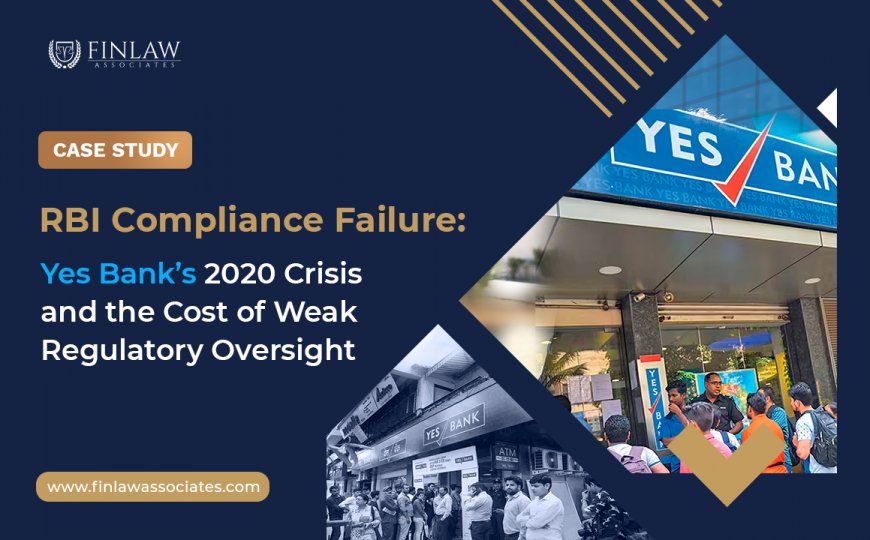
In March 2020, India experienced one of the most drastic banking crises in its recent financial history. The Reserve Bank of India (RBI) imposed a moratorium on Yes Bank (which had been hailed as one of India's fastest-growing private sector banks) and imposed limits on customers withdrawing their funds. As a result, depositors lost faith in the bank and the value of shares declined sharply.
The Yes Bank crisis was not only a sudden shock to the economy but also to years of regulatory problems, inadequate governance, too much concentration of risk in few places, and lack of compliance with laws.
The near demise of Yes Bank serves as a powerful reminder that regulatory supervision is not simply a procedure – but rather an act that has meaning and value. Banks must constantly comply with the RBI's rules, prudential regulations, governance standards, and other regulations for the rest of their lives.
The case study will explore what happened, how regulatory problems accumulated, what the results have been from supervisory involvement, and the lessons learned by those who supervise any financial institution or entity that is subject to the rules imposed by regulators.
The High-Growth Banking Model: Background
Since its creation in 2004, Yes Bank has established itself as a fast-paced, aggressive private-sector lender that had quickly built a reputation for providing customers with a broad range of products and services. By mid-2010s, Yes Bank had developed into one of India's largest and most respected banking organisations.
Yes Bank's growth rate and profitability meant that investors have given Yes Bank a premium price-to-earnings ratio (P/E ratio). The market viewed Yes Bank as innovatively leading through its entrepreneurial nature and aggressive growth strategy.
While the above information highlights Yes Bank's rapid growth, it does not represent the bank's structural failings.
What Happened: Warning Signals and Compliance Gaps
The Yes Bank crisis did not develop in a day, but rather, has taken shape over time, with regulatory deficits, asset quality deterioration and governance issues combining to create an environment for failure.
Red Flags Ignored
The Reserve Bank of India (RBI), as the central banking regulator, has repeatedly cautioned the industry regarding their concerns about Yes Bank's asset quality disclosures and provisioning.
The most important aspects of the RBI's regulatory concerns appear to be as follows:
-
Under-reporting of Non-Performing Assets (NPAs).
-
Diversions between the RBI's inspection findings and the bank's declared asset classifications.
-
High level of exposure to stressed corporate borrowers.
-
Concentration risk in certain sectors.
The RBI's inspection report once again presented evidence of inaccuracies about how the bank has recognized its assets. However, once again, no timely corrective actions were taken internally by bank management.
The large divergence between the RBI's determination of the bank's bad loans and the bank's own disclosures is an obvious sign that there is a weakness in compliance, and in this case, there were numerous instances where the RBI communicated that such a divergence existed.
However, the governance structure existed in Yes Bank did not seem to be sufficient to provide an adequate response to these signals that were identified by the RBI.
Inadequate Compliance Monitoring
Banks function in a highly regulated environment with a lot of rules. Some of these rules include:
• Directions from the Reserve Bank of India (RBI).
• Prudential standards for capital adequacy.
• Guidelines for asset classification and provisioning.
• Ceiling on credit.
• Guidelines on corporate governance.
It is essential that internal monitoring be conducted continuously.
Yes Bank had large concentrations of risk in corporate sectors that were under financial stress and were largely unchecked. Systemic risk was created by lending too much money to borrowers who could not repay. There were inadequate internal controls to elevate risk to the Board for corrective action.
Compliance was reactive rather than proactive.
Challenges Related Governance and Oversight of Board
A banking institution’s governance requires independent directors, audit committees, and risk committees to be appropriately independent.
Subsequently raised questions were:
-
If board level mechanisms for the assessment of risk are cohort level mechanisms.
-
If there was adequate escalation of divergence findings.
-
If the structure of internal audit and compliance reports flags the systemic exposure risks interrelated with such mechanisms.
-
If there had been actual plans in place to address concerns related to capital adequacy.
The strength of a banking institution is derived not only from financial growth, but through governance discipline, which has been made evident as a result of this crisis.
RBI Measures: Moratorium on Yes Bank
On 5 March 2020, the Reserve Bank of India placed a moratorium on Yes Bank and invoked Section 45 of the Banking Regulation Act 1949.
The fall out was immediate and by far the biggest ever response by an Indian private sector bank to a crisis of its kind. Four significant events occurred:
-
Withdrawal capped at ₹50,000 per person for customers, (with some limited exceptions)
-
The board of the bank was superseded
-
An administrator was appointed to manage the bank
-
Panic buying in the market
The goal of the RBI intervention was to contain systemic contagion. The health of the banking system represents the foundation of all financial systems and if a major private bank fails, it can erode confidence in all financial institutions.
Effects of the Crisis
The impact of the crisis was very large and across many areas of our economy.
1. RBI-Imposed Moratorium
The moratorium placed restrictions on depositors’ access to their funds resulting in a decrease in the perception of liquidity. This caused a loss of trust in the private banking sector even though the moratorium was temporary.
Once depositor confidence is lost it is extremely difficult to restore.
2. Severe Reputational Damage
Picture an image being built over many years only to have that image destroyed within days. Yes Bank’s reputation suffered a tremendous amount of damage. Years of positioning the Yes Bank brand for growth were undone within a few days. Investors adjusted their exposure levels to Yes Bank and customers adjusted the level of their relationships with the banking institution that previously had a reputation for providing reliable services.
Reputation is capital in the financial service industry.
3. Erosion of Capital
Yes Bank’s share price fell dramatically. Yes Bank’s market cap dropped significantly. Investor wealth was decimated.
A confluence of high-risk lending practices, inadequate provisioning, and weak capital buffer conditions came to a boiling point at this time.
4. Emergency Restructuring
The RBI orchestrated a rescue plan led by State Bank of India (SBI) and other institutional investors. A reconstruction scheme was implemented.
Key measures included:
-
Fresh capital infusion.
-
Lock-in restrictions for certain shareholders.
-
Reconstitution of the board.
-
Strengthened oversight mechanisms.
The intervention prevented collapse but fundamentally altered ownership and governance structures.
Regulatory Authority: Role of the Reserve Bank of India
The Reserve Bank of India functions as:
-
Monetary authority.
-
Banking regulator.
-
Financial stability guardian.
-
Prudential supervisor.
Under the Banking Regulation Act, RBI holds extensive powers to:
-
Conduct inspections.
-
Issue directions.
-
Impose restrictions.
-
Supersede boards.
-
Initiate moratoriums.
-
Facilitate reconstruction.
The Yes Bank episode demonstrated RBI’s willingness to exercise emergency supervisory powers to safeguard systemic stability.
Regulatory tolerance for prolonged compliance deviations is limited, particularly in banking.
Structural Lessons from Yes Bank’s Crisis
The crisis has highlighted several structural realities about RBI regulated entities.
1. Regulatory/Breaches as a Critical Warning Signal
Repeatedly diverging from a single asset classification is not an insignificant, trivial deviation; it is a signal of systemic reporting weaknesses and/or potential governance problems.
There must be timely correction mechanisms embedded within the organization’s compliance frameworks.
2. Risk Discipline versus Growth
RBI master directions stipulate that banks must balance growth targets against prudent exposure management, particularly when lending aggressively to the distressed sectors of the economy.
3. Board Reporting Needs to Be Actionable and Structured
In addition to being merely information based, compliance reporting has a requirement to provide the basis for decision making at the Board level.
Good quality legal and regulatory retainership can contribute to:
- A robust framework for the Board’s risk reporting.
- Appropriate escalation protocols.
- Sufficient documentation discipline.
- Holding the Board accountable for corrective action taken.
4. Capital Adequacy Is Not Negotiable
RBI’s capital adequacy norms under Basel frameworks exist to absorb stress shocks.
Proactive capital planning reduces emergency restructuring risk.
The Importance of Maintaining Continuous Legal and Regulatory Retainership
The Yes Bank incident shows that there is a continuous approach to regulatory supervision rather than an episodic one.
A robust structure for a Legal and Regulatory Retainership that has been designed will help an entity that is regulated to:
Assess the Regulatory Exposure
By conducting regular internal reviews in accordance with the RBI master directions, an entity may identify potential early warning signs.
Ensure Ongoing Compliance to the RBI Frameworks
Continual tracking of the entity’s compliance to:
-
Asset classification norms
-
Provisioning requirements
-
Capital adequacy requirements
-
Limits of exposure
-
Corporate governance norms
Strengthen the Board Level Oversight
Legal advisors can create a structured compliance dashboard specifically for the boards, ensuring that the directors remain adequately informed of any situation as well as be protected.
Directors that work for a regulated entity are personally liable. Documentation of the boards oversight of the entity will reduce personal exposure for the individual directors.
Prevent the Need for Emergency Regulatory Action
There are events (i.e. emergency moratoriums, board supersession and reconstruction schemes) whereby the entity may be forced to implement an emergency intervention, as a last resort.
Through the implementation of a preventive compliance framework, you can prevent the need for a regulatory action.
Broader Implications for NBFCs and Regulated Entities
While Yes Bank was a scheduled commercial bank, the lessons extend to:
-
NBFCs.
-
Payment banks.
-
Fintech companies.
-
RBI-licensed financial institutions.
Regulatory expectations are increasing. Supervisory technology (SupTech) tools enable regulators to detect anomalies faster.
Institutions must invest in:
-
Internal audit strength.
-
Legal compliance review.
-
Risk governance architecture.
-
Real-time reporting systems.
Reactive compliance models are no longer sufficient.
The Costs Associated with Failing to Respond to Regulatory Signals
The financial implications of the Yes Bank crisis were substantial; however, the indirect consequences are even larger:
-
Loss of trust from depositors
-
Decrease in the value of the brand
-
Withdrawal of institutional investors
-
Additional scrutiny by compliance
-
Long-term scepticism in capital markets
To recover from this event will take many, many years. To prevent such an event from taking place again will require structure.
Compliance Needs Banking Infrastructure
Yes Bank’s failure was not just about being short of cash; it was about poor governance and compliance.
The Bank of India was involved to help with the systemic stability that had been lost because of the slow and poor action taken to address the situation.
In finance, survival will be dependent on pro-actively aligning to what the regulators say.
The Yes Bank crisis has been a long-standing document proving the price of not being compliant with regulators, and that we must embed compliance processes as opposed to assuming compliance processes exist and will always work.
What's Your Reaction?