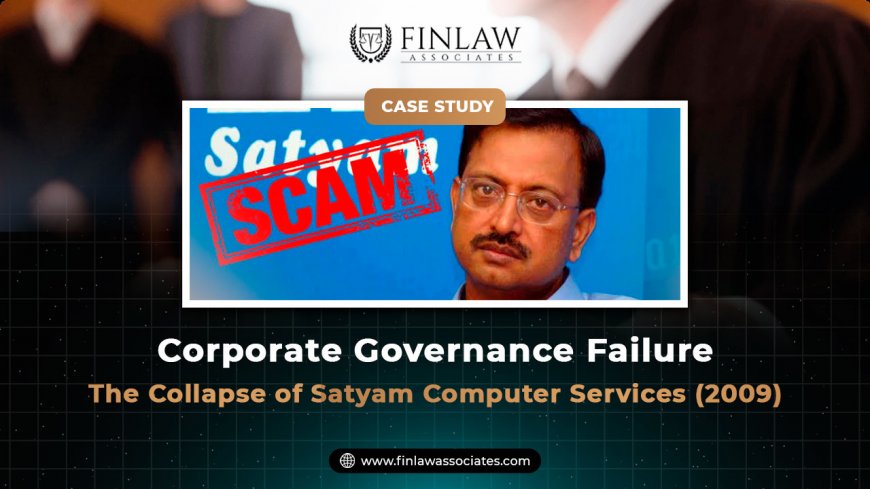
Case Study: Corporate Governance Failure - The Collapse of Satyam Computer Services (2009)
Explore the 2009 Satyam scandal—India’s biggest corporate governance failure—its causes, legal impact, SEBI reforms & key lessons for directors.

Corporate governance is often discussed in policy documents and annual reports. But its true importance becomes visible only when it collapses.
The Satyam Computer Services scandal (2009) is best noted as one of India's largest corporate governance failures. It was much more than an accounting fraud. It was a total breakdown of governance through failure with controls, management oversight, compliance, director accountability, and the entire governance process.
As a result, the case transformed Indian corporate law, enhanced the disclosure regulations, and changed the way that regulators, investors, and directors approach their risks with regards to corporate governance.
This case study will review the events surrounding the Satyam Computer Services scandal from the perspective of what happened, why it took place, what were the regulatory and market responses, and what are the lessons that today's business owners must apply to their companies.
Background:
The Satyam Corporation, a well-known IT outsourcing company was formed in 1987 and quickly became one of India's most successful IT outsourcing companies. It has earned an international presence with service to Fortune 500 companies, first as a public company on Indian stock exchanges and second as a public company on the New York Stock Exchange.
Up to the end of the 2008 financial year Satyam Computer Services:
-
Had more than 50,000 employees.
-
Increased revenue consistently.
-
Had significant foreign institutional ownership.
-
Was considered a representation of India's IT excellence.
-
Was viewed as a financially stable and operationally robust company.
This company was able to create this image for a prolonged period through false accounting.
Satyam's Admission: A Shock to the Market
On January 7, 2009, Ramalinga Raju, the CEO of Satyam Computer Services, issued a letter to the board of directors admitting to numerous violations of GAAP and the manipulation of company financials.
Included in this letter are:
-
The company's cash and bank account balance has been materially inflated.
-
Revenue and other income have been materially inflated.
-
The profit margin is materially inflated through accounting manipulation.
-
Interest income is materially fabricated.
-
Liabilities were materially understated.\
The difference between the various line items in the above-mentioned categories would be in the range of thousands of crores of rupees.
What appeared to be a strong performance, was a falsified accounting system which had been taking place over many years. The fraudulent act did not just happen in January 2009 but has been in the company's reporting system for quite some time.
Core Governance Failures
The Satyam Crisis was not exclusively about fraudulent accounting; there were also numerous instances of poor governance across different levels of the organisation which contributed to the failure.
1. Lack of Oversight by The Board
Independent directors are responsible for advocating for the best interests of the shareholders, as well as ensuring that there is an appropriate level of accountability on the part of management.
However, in the case of Satyam:
-
The board did not take the time necessary to review and assess the financial statements prepared.
-
The reporting of large cash balances in the balance sheet did not have an independent assurance.
-
Red flags in operational margins were not adequately questioned.
-
The board largely relied on the information presented to them without sufficiently challenging or questioning it.
This demonstrates that although the board members may have been formally independent of management, they were not operationally independent.
2. Insufficient Legal and Compliance Monitoring
Disclosure, from a corporate standpoint, not only requires accurate financial reporting, but also requires corresponding oversight by an external counsel.
There was no systematic internal training mechanism ensuring:
-
Ongoing compliance with listing standard
-
That financial reporting systems and subsequent disclosures were subject to an independent cross-review.
-
There was no independent legal validation of the accuracy of Financial Disclosure Report
-
There was no consistent process for escalating issues related to risk.
With no legal monitoring, governance had devolved to an emphasis on documentation rather than an emphasis on verification.
3. Inadequate Risk Management Systems
Effective governance requires:
-
Risk mapping,
-
Control testing, and
-
Compliance auditing.
Satyam did not have an established compliance risk framework to identify variances between cash balances reported in the financial disclosure report and cash balances corroborated by independent confirmation from banks.
Satyam's internal control system was not strong enough to detect and escalate variances.
4. Audit Reliance Without Layered Safeguards
Within the context of governance infrastructure, external auditors play a vital role in being gatekeepers to assure the accuracy of financial statements. Alone, the audit cannot adequately provide the necessary oversight of an organization’s governance infrastructure.
The case outlined above demonstrates that:
-
Audit oversight needs to be supplemented by an organization’s internal compliance system.
-
Adding legal review of disclosures provides another layer of protection, in addition to audit oversight.
-
Board audit committees need to have the ability to enforce and implement the provisions of their charter effectively.
-
A governance system that relies on one line of defense makes that governance system intrinsically vulnerable.
Immediate Market Consequences
Satyam experienced immediate repercussions for its admission of guilt.
Share Value Plummets
Satyam's share price dropped rapidly following the announcement, wiping out the wealth of investors in hours.
Institutional investors sold their holdings in response to the decline in investor confidence in Satyam's future.
International Reputation Damaged
The scandal not only destroyed the value of Satyam's goodwill but also significantly reduced India's reputation for being a good place for business.
International clients questioned:
-
The governance practices of Indian companies
-
The integrity of financial statements of Indian companies
-
The regulatory regime for enforcing corporate compliance
The scandal was compared to the Enron debacle in America.
Regulatory Shock Waves
Immediate investigations into the events leading to the crisis were initiated by Indian regulatory authorities such as the SEBI and the Ministry of Corporate Affairs. Government intervention has been seen through:
-
The dissolution of the existing board
-
Appointment of new directors
-
Supervisory oversight of the restructuring process
The level of government intervention indicates the systemic importance of failure in the governance framework.
Legal Implications and Criminal Charges
The charges against the promoter and senior executives have resulted in the following outcomes:
-
Prosecution of the promoter and senior executives
-
Charges filed against the promoter and senior executives
-
Exposure of civil liability
-
An inquiry into the actions/inaction of the auditor
It is important to note that governance failure is not simply a reputational issue - there are personal legal consequences.
Directors in India may face consequences under Indian law:
-
Civil penalties
-
Disqualification (from being a director)
-
Criminal liability
Directors need to have proper governance structures in place prior to the event occurring, rather than attempting to form structures in the "after-the-fact".
Systemic Impact on Indian Corporate Law
The Satyam case triggered significant regulatory reform.
Strengthening of the Companies Act
The Companies Act, 2013 introduced:
-
Enhanced director duties
-
Stricter governance norms
-
Mandatory audit committee frameworks
-
Greater accountability standards
SEBI Disclosure Reforms
SEBI strengthened:
-
Disclosure requirements
-
Insider trading regulations
-
Board-level compliance obligations
-
Independent director accountability
The regulatory framework evolved to reduce the probability of similar governance failures.
The Technical Mahindra Acquisition
To stabilize services and restore confidence in the process at Satyam following the disarray after the collapse of the organisation, the Government of India provided a mechanism for Tech Mahindra to purchase Satyam. This acquisition provided a framework to:
1. Maintain client relationships
2. Protect employee jobs
3. Stabilize operations; and
4. Prevent significant IT sector disruption
However, not all corporate failures result in government intervention.
Most governance issues lead to either liquidation or damage to the brand over the longer term.
Root Cause Analysis of Why the Fraud Was Not Found Earlier
The scandal persisted because governance was reactive rather than preventive.
Key Structural Weaknesses:
-
Lack of Periodic Governance Audits
-
No Risk Mapping for Compliance
-
Weak Internal Legal Oversight
-
Limited Financial Inquiry at Board Level
-
Poor Integration between Finance, Compliance, and Governance Functions
-
Compliance was viewed as an Annual Exercise.
Lessons for Current Corporations
The Satyam scandal is relevant in today's world.
Reasons are:
-
There is an increase in regulation enforcement.
-
There are digital report systems.
-
There is more scrutiny from global investors.
-
There are regulatory requirements for compliance with Accounts Money Laundering and Prevention of Money Laundering.
-
The speed of governance failures is increasing.
The following are examples of lessons current corporations should derive from these events:
1. Governance as a Structure
Governance needs to be embedded within the processes of the organisation rather than just within Board meetings.
2. Continuous Legal Oversight Remains Critical
Having a legal retainer on board is extremely crucial. The need for legal compliance auditing extends to include:
-
The monitoring of disclosures
-
The checking of regulations
-
The protection of Directors
-
The enforcement of contract compliance
3. Risk Mapping Lowers the Risk of a Major Loss
Proactive audit type compliance reduces vulnerability to new exposures early.
4. Structured Systems Required for Protection of Directors
Independent Directors require a documented compliance file to limit their liability.
5. Transparency Protects Company Value in the Market
A company’s value in the market is only as good as the trust it builds by providing its investors with sufficient information via credible mechanisms.
What Strong Governance Structures Could Have Prevented
A structured corporate retainer by the legal profession could have:
-
Conducted quarterly governance audits
-
Reviewed all financial disclosures for compliance with regulatory requirements.
-
Identified any inaccuracies in the reported reserves.
-
Required rigorous documentation at the board level.
-
Created a method for escalating compliance issues.
-
Limited the promoter's discretion.
For prevention it requires institutional structure.
The Satyam scandal has fundamentally changed the landscape of corporate governance in India. The scandal illustrates that a lack of internal controls and oversight will lead to the loss of enterprise value, regardless of the success of the business’s operations.
Governance is about protecting the credibility of the institution.
In today’s regulatory landscape, continuous and structured legal oversight is not an option, it is a requirement.
The Satyam situation is an example of how governance failures can take place over time without being noticed until there is an explosion of information regarding the issue.
Once there is an explosion of information regarding governance failures, there is no guarantee of recovery.
What's Your Reaction?